
If you are a contractor working across state lines, or simply trying to figure out what your home state requires before you pull your first permit, you have probably discovered that there is no single national answer. Licensing authority, bonding requirements, and insurance mandates are set at the state level and in many cases pushed down further to the city or county. What is required in Nevada has little to do with what is required in Illinois.
This page pulls together what we know from state licensing board data and industry research to give contractors and their advisors a working overview of how the regulatory landscape looks in 2025.
Who Actually Issues Contractor Licenses?
The first thing most contractors learn is that not every state handles licensing the same way. Our research breaks the country into three categories:
State-licensed states issue a single statewide contractor license through a dedicated board or agency. If you hold a license in one of these states, it is valid anywhere within that state.
Local-authority states push all licensing decisions down to the city or county level. There is no statewide contractor license to hold. A contractor working in multiple municipalities within the same state may need to carry multiple local licenses simultaneously.
Hybrid states use a combination of both. A statewide license may cover certain trades or project types, while cities or counties layer on additional local requirements on top.
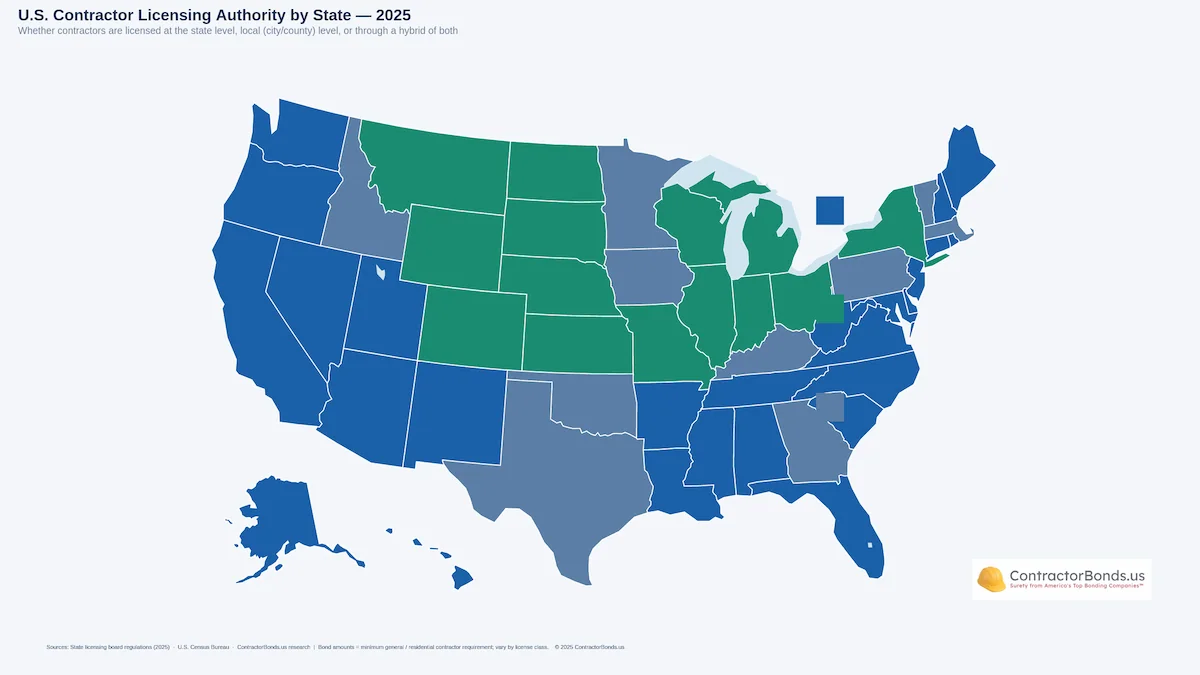
This distinction matters more than most contractors realize. A contractor expanding from a local-authority state into a state-licensed state often underestimates the compliance lift involved because the paperwork process looks completely different.
What Financial Requirements Do States Impose?
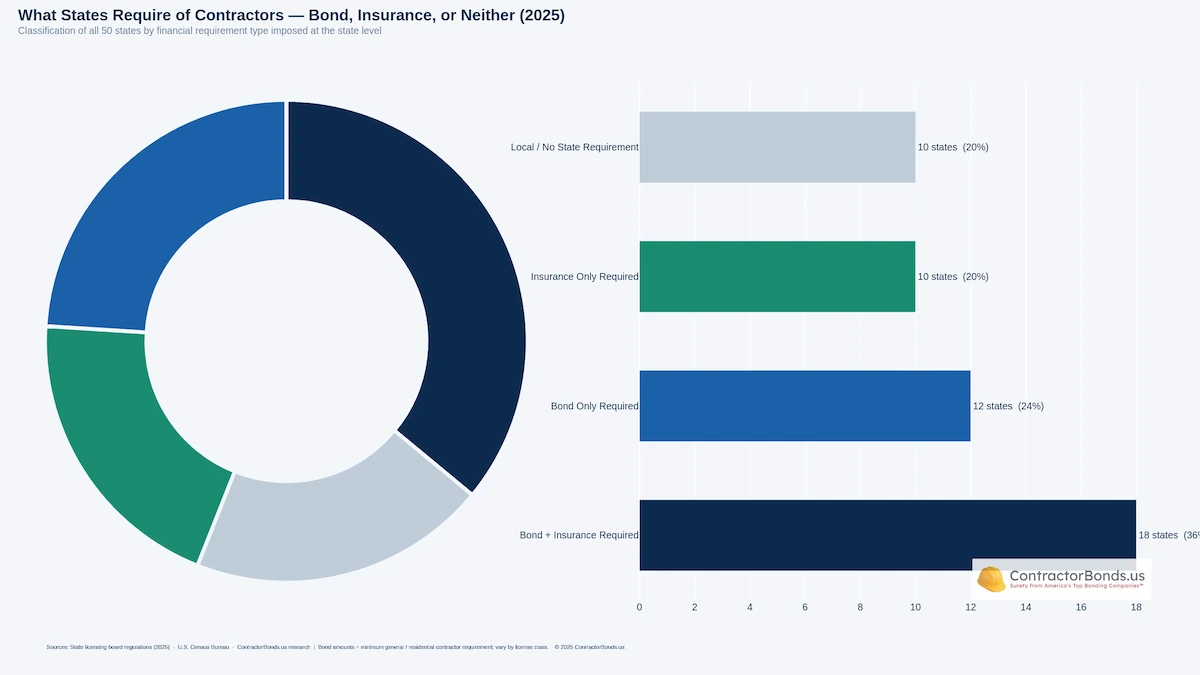
Beyond the license itself, states impose financial requirements designed to protect consumers and the public. These fall into four broad categories:
Bond plus insurance required. The most common arrangement. Roughly 18 states require contractors to carry both a surety bond and general liability insurance as conditions of licensure. This is the strictest tier of consumer protection and the most common among states with robust statewide licensing boards.
Bond only required. Approximately 12 states require a surety bond but stop short of mandating liability insurance at the state level. Insurance may still be required by local jurisdictions, individual clients, or general contractors on projects.
Insurance only required. About 10 states require proof of general liability insurance but do not impose a statewide bond requirement. In some of these states, bonds are required only for specific trades, project types, or non-resident contractors.
Local requirement or no statewide mandate. Another 10 states leave financial requirements entirely to local governments, or impose no financial requirement at the state level at all. This does not mean contractors in these states operate without accountability, but it does mean the contractor must investigate county or municipal rules directly.
What Do Contractor Bonds Actually Cost?
The bond amount set by a state is not what you pay. It is the maximum that can be paid out on a claim against the bond. Contractors pay a premium, typically 1 to 3 percent of the total bond amount annually for applicants with good credit.
A few benchmarks based on current state licensing board figures:
Nevada sets bond amounts based on the contractor's classification and annual volume, and they can run high, ranging from a few thousand dollars to well over $50,000 for larger commercial contractors.
California requires a $25,000 contractor license bond for all licensed contractors, a figure that was increased from $15,000 in January 2023 under Senate Bill 607.
Washington raised its general contractor bond requirement to $30,000 in 2024, up from $12,000 previously, a 150 percent increase.
Oregon now requires a $30,000 bond for residential general contractors, with commercial contractors facing higher thresholds depending on their license level.
Arizona uses a sliding scale tied to annual gross volume, with bond amounts ranging from around $9,000 up to $100,000 for the largest contractors.
At the lower end, states like Hawaii, Georgia, New Hampshire, and several others set minimums between $1,000 and $5,000. Bond premiums in those states can be as low as $100 per year.
The takeaway: the dollar cost of bonding is usually a small operating expense. The consequence of operating without a required bond is not. Unlicensed or unbonded contractors in states with mandatory requirements risk misdemeanor charges, loss of license, and loss of the legal right to collect payment for completed work.
Recent Trends Worth Watching
A handful of meaningful changes have taken effect in the past two years:
California increased its contractor bond from $15,000 to $25,000 effective January 1, 2023 - a 67 percent increase driven by consumer protection legislation.
Washington raised its general contractor bond from $12,000 to $30,000 effective July 1, 2024.
New Jersey implemented an entirely new tiered bonding system effective March 31, 2025, replacing a previous structure that carried no universal mandate. NJ contractors renewing after that date now face bond requirements ranging from $10,000 to $50,000 depending on license tier.
Oregon increased bond requirements effective January 1, 2024 across multiple license categories.
The overall trend is upward. Bond minimums across states that do require bonds have generally increased over the past decade, consistent with inflation in construction costs and increasing claims activity.
How to Find Your State's Requirements
Every state with a statewide licensing board maintains a public website with current bond and insurance requirements. Requirements can and do change when state legislatures act, so the safest approach is always to verify directly with your state board before applying or renewing.
If you need a contractor bond in any state, ContractorBonds.us works with licensed surety agents nationwide and can provide a quote quickly, often the same day.
https://contractorbonds.us/surety/
Sources: State licensing board regulations (2025). U.S. Census Bureau. ContractorBonds.us research. Bond amounts reflect minimum general or residential contractor requirements and vary by license class. Legislative changes sourced online 2025 analysis and official state board publications.